

Our Instruments
Sources
Voice of the Turtle learns most of its repertoire from field recordings housed
in Jerusalem at the Jewish Music Research Center, at Hebrew University and
at the radio station Kol Yisrael. These versions were collected by radio-journalists,
scholars, and ethnomusicologists from Sephardi communities in Israel, documenting
many versions of the songs which have been preserved by oral tradition.
Arrangements
Since this repertoire is a dynamic compilation created during more than 500 years
of diaspora, the variety of musical genres is considerable. By our process of
'creative conjecture' influenced by the function, musical modes, texts, and spirit,
art of the song, the members of Voice of the Turtle work collaboratively to envision
and create the instrumental and vocal arrangements.
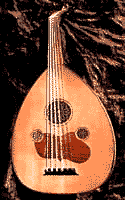
The 'ud is the classical Arabic lute, believed to have its origin in ancient Persia. This member of the family of short-necked lutes is found throughout the Levant, North Africa and the Middle East. The fretless 'ud, or oud, has 6 courses of strings made of nylon and metal. The body is comprised of staves. In Europe, it was transformed by the addition of frets into the lute during the middle ages, and it remained popular through the Baroque period.
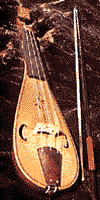
The Rebec is a type of violin, a bowed middle eastern instrument still played in Turkey and other Middle eastern countries.

A copy of a Medieval style Psaltery, a plucked instrument. The Psaltery is one of the instrumemts mentioned in the bible.
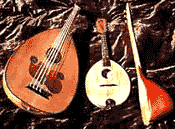
SAZ This member of the long-necked lute family comes from Turkey where several similar instruments are played including the larger baglama. The family is distinguished by its single piece carved body, a long neck to which frets are tied, and three pairs of wire strings.
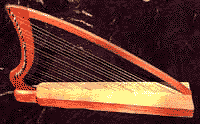
This is a copy of a Medieval Harp
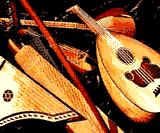
Harp, Psaltery, 'Ud, Saz and Rebec